Best Power Wheels for 2-Year-Olds
The best ride-on cars for 2-year-olds — with honest guidance on why parental remote control isn't optional at this age. Safety and remote control are the entire purchase decision.
Affiliate Disclosure
This page contains affiliate links. As an Amazon Associate, PowerWheels HQ may earn a commission on qualifying purchases at no extra cost to you. Our reviews and recommendations are editorially independent.
Looking for the best power wheels for 2-year-olds? Our top pick is the Bumper Car for Kids with Remote Control. It leads this guide as top pick overall — compact, safe, parental remote included with a 4.6/5 rating. The full comparison and the tradeoffs are below.
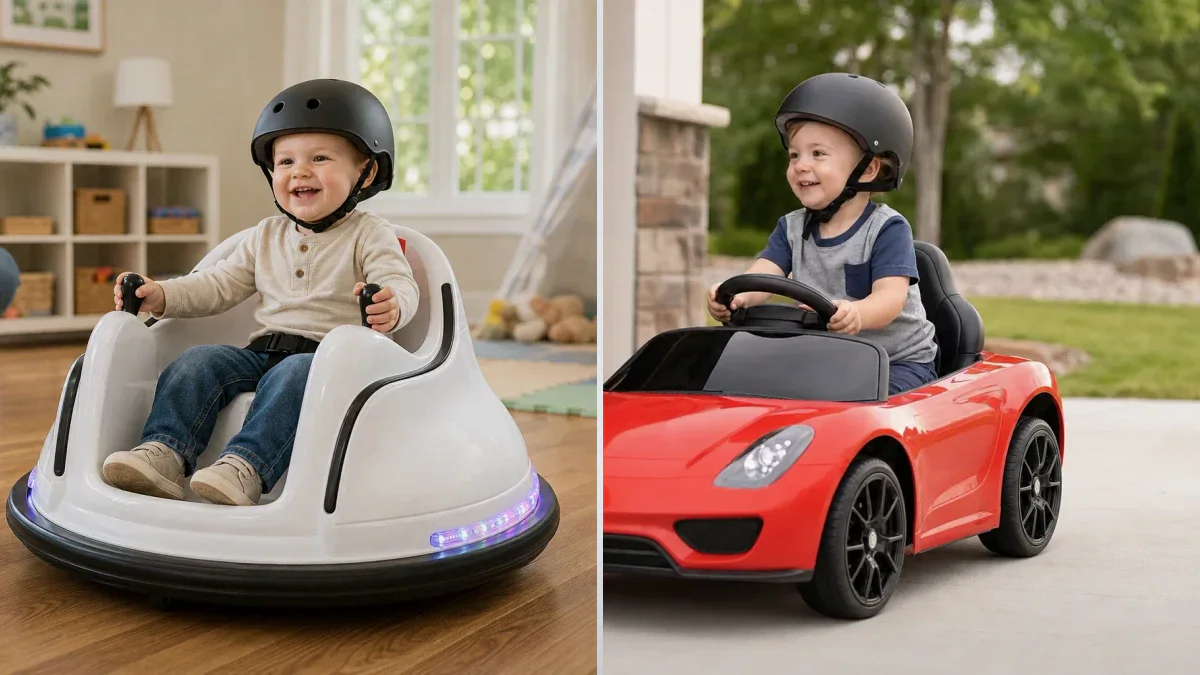
At 1 year old, a parental remote control is not optional. This is not a feature to weigh against Bluetooth speakers or scissor doors. At 2 years old, the same principle still applies. A 2-year-old in a moving vehicle that they control is not safe without a parent who can stop it.
This is the entire purchase decision for this age group. Everything else — color, theme, brand, voltage — is secondary. If the ride-on you're considering doesn't have a parental remote control, cross it off the list.
Why Remote Control Is Non-Negotiable at Age 2
A 2-year-old has essentially no ability to react to a hazard, judge distance from objects, or make a split-second decision to stop. Their motor coordination is developing but nowhere near the level needed to drive a vehicle safely in a real environment. They don't understand that the car doesn't stop immediately when they take their foot off the pedal. They don't know not to drive toward the pool, the garage wall, the street, or the dog.
The parental remote control solves this. You watch. You steer or stop when needed. Your child feels like they're driving. Everyone is fine.
Many parents skip the remote and then return the vehicle after an incident. Don't do that. Buy the remote version first.
6V vs. 12V at Age 2
For a true 2-year-old — not an almost-3-year-old — 6V is often the right voltage. The scale is more appropriate (smaller vehicle, lower seat height), the speed is more appropriate (2.5 mph is fast enough for a toddler), and the lower cost reflects the reality that this vehicle has about a 12-18 month use window before they grow out of it.
That said: if you want a 12V vehicle because you have a remote control included and you want slightly better performance, that's fine. Just make sure the remote is present and functional before you finalize the purchase.
What 2-Year-Olds Actually Want
Here's the developmental reality: at 2, kids don't have strong brand opinions. They don't need a licensed Lamborghini. They want to sit in a car, press the pedal, and go. The theme is parent-selected at this age more than child-selected.
Buy the vehicle that has the right safety features and the right scale for a 2-year-old. If the pink one and the blue one both have remote controls, let your toddler pick by pointing.
Bumper Cars Are an Underrated Option
The Kidzone bumper car is worth specific mention for the 2-year-old parent. It's compact, it operates at low speed, it spins in place (which toddlers find hilarious), and it has a parental remote. For indoor use or small spaces, it's often a better fit than a traditional ride-on car.
The Session Length Reality
At age 2, your child will ride for 10-20 minutes and be done. They're not going to do the 45-minute backyard laps that a 4-year-old does. Don't overbuy on battery capacity for this age group. The vehicle will spend most of its time sitting charged and waiting for the next 15-minute session.
Who Should Buy 6V and Who Should Buy 12V at Age 2
Buy 6V if: your child is just turning 2, you have a small space, or you want the most age-appropriate scale and speed.
Buy 12V if: your child is closer to 3, you want the vehicle to last into age 4, and you're buying a version that includes a parental remote control.
Quick Comparison
Bumper Car for Kids with Remote Control
Kidzone
Top pick overall — compact, safe, parental remote included
- Voltage
- 6V
- Seats
- 1
- Ages
- 1.5-4
- Price
- $100-$150
Jeep Wrangler 6V with Remote
Power Wheels
Best traditional ride-on for 2-year-olds with remote option
- Voltage
- 6V
- Seats
- 1
- Ages
- 1.5-4
- Price
- $140-$200
12V Kids Ride-On Car with Parental Remote
Best Choice Products
Best for parents who want 12V but need a remote for a young toddler
- Voltage
- 12V
- Seats
- 1
- Ages
- 2-5
- Price
- $150-$210
Mini Cooper Style 6V Ride-On
Costzon
Best value pick for a true toddler (1.5-2.5 years)
- Voltage
- 6V
- Seats
- 1
- Ages
- 1-3
- Price
- $100-$140
| Product | Best For | Specs | Price | Rating |
|---|---|---|---|---|
Bumper Car for Kids with Remote Control Kidzone | Top pick overall — compact, safe, parental remote included | 6V · 1 seat Ages 1.5-4 | $100-$150 | 4.6 |
Jeep Wrangler 6V with Remote Power Wheels | Best traditional ride-on for 2-year-olds with remote option | 6V · 1 seat Ages 1.5-4 | $140-$200 | 4.5 |
12V Kids Ride-On Car with Parental Remote Best Choice Products | Best for parents who want 12V but need a remote for a young toddler | 12V · 1 seat Ages 2-5 | $150-$210 | 4.2 |
Mini Cooper Style 6V Ride-On Costzon | Best value pick for a true toddler (1.5-2.5 years) | 6V · 1 seat Ages 1-3 | $100-$140 | 4.0 |
Prices are approximate and subject to change. Always verify current pricing before purchasing.
Our Picks — In Detail
Bumper Car for Kids with Remote Control
Kidzone
6VSeats
1Ages
1.5-4Price
$100-$150
The top pick for 2-year-olds. The Kidzone bumper car is compact enough for indoor use, has a genuine parental remote, operates at a speed appropriate for toddlers, and spins in place — which 2-year-olds find genuinely entertaining. It's designed for this age in a way most ride-on cars are not.
Pros
- Parental remote control included
- Compact — works indoors and in small spaces
- Spin-in-place feature delights toddlers
Cons
- Not a traditional car look — not for kids who want a truck or Jeep aesthetic
- 6V limits outdoor terrain performance
Jeep Wrangler 6V with Remote
Power Wheels
6VSeats
1Ages
1.5-4Price
$140-$200
The Power Wheels Jeep at 6V is properly scaled for toddlers and has a parental remote version available. It's the right vehicle if you want something that looks like a real car rather than a bumper car. Keep it on flat surfaces — 6V won't manage grass.
Pros
- Licensed Jeep styling
- Right scale for 2-year-olds
- Power Wheels reliability
Cons
- 6V means pavement and flat hard surfaces only
- More expensive than non-licensed alternatives
12V Kids Ride-On Car with Parental Remote
Best Choice Products
12VSeats
1Ages
2-5Price
$150-$210
For the parent of a 2-year-old who wants the vehicle to still be appropriate at ages 4-5, a 12V with parental remote is the right call. The 12V performance is more than a 2-year-old needs, but the remote keeps it safe and the vehicle has a longer useful life.
Pros
- Parental remote gives safety at any voltage
- 12V extends the useful age range to 5
- More affordable than licensed alternatives
Cons
- 12V is more power than a 2-year-old needs
- Non-licensed generic styling
Mini Cooper Style 6V Ride-On
Costzon
6VSeats
1Ages
1-3Price
$100-$140
A budget-friendly 6V option in a compact scale genuinely appropriate for the youngest end of the toddler spectrum. Comes with a parental remote. Not a premium build, but the right size, the right speed, and the right price for a toddler who will outgrow it in 18 months.
Pros
- Right scale for the youngest toddlers
- Parental remote included
- Lower price reflects the short use window
Cons
- Build quality is budget-tier
- 6V limits it to flat hard surfaces only
What to Look For
Voltage (6V / 12V / 24V)
Higher voltage means more power, higher top speed, and better terrain handling. Choose based on your child's age, size, and where they'll ride. 12V is the most popular choice for ages 3–7.
Number of Seats
Single-seat models work for one child; two-seat designs are great for siblings or friends. Two-seaters often put more strain on the motor, so look for adequate power.
Terrain
Most 12V ride-ons handle flat grass and hard surfaces. If you have hills, rough grass, or gravel, look for 24V models with high-traction tires.
Safety Features
Look for seat belts, parental lockout switches, low/high speed settings, and parental remote controls — especially for younger or first-time riders.
Battery & Charging
Check battery life (usually 1–2 hours for 12V) and charge time (8–18 hours). Some premium models offer faster charging or higher-capacity batteries.