Power Wheels Dune Racer vs. Dune Racer Extreme: What You're Actually Paying For
Dune Racer vs. Dune Racer Extreme, settled: what's actually different (battery, wheels, graphics), what's identical (everything structural), and which one to buy at which price.
Affiliate Disclosure
This page contains affiliate links. As an Amazon Associate, PowerWheels HQ may earn a commission on qualifying purchases at no extra cost to you. Our reviews and recommendations are editorially independent.
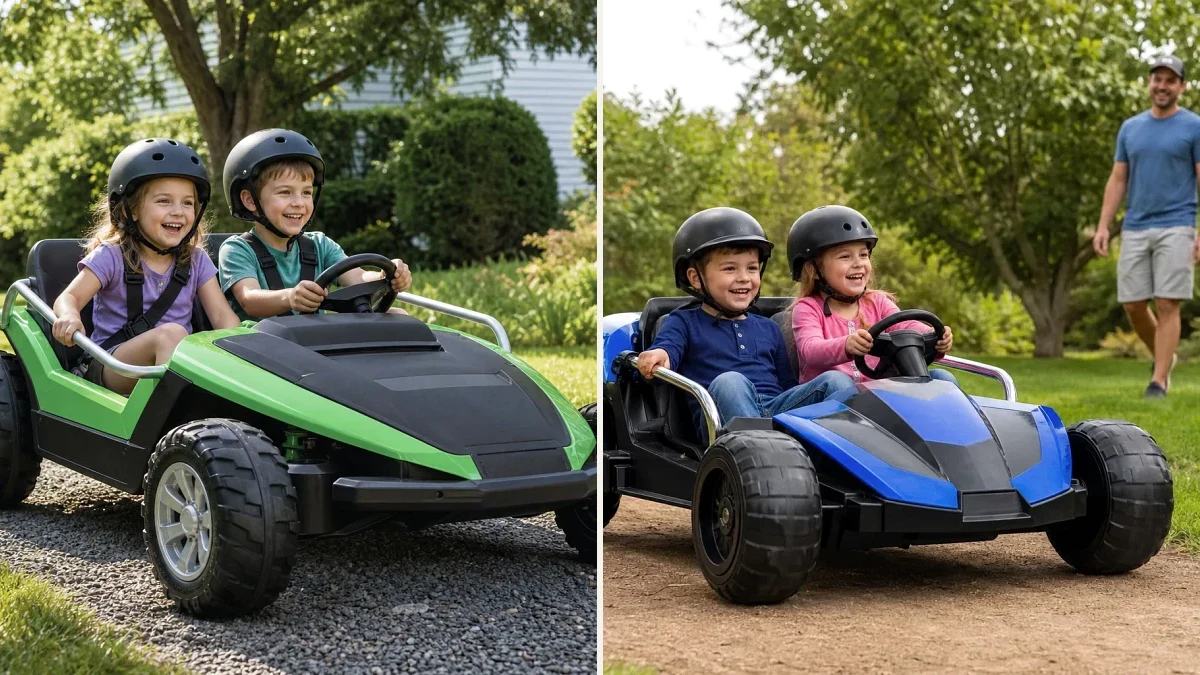
Buy the Dune Racer Extreme if both are in stock and the gap is the usual $30-50. Buy the standard Dune Racer if it's on a real discount — because underneath the graphics, it is the same vehicle, and a good price on the same vehicle beats a full price on slightly better wheels.
That's the whole decision. Now here's why.
What's Actually Different
Mattel sells two versions of the same open-cockpit off-roader, and the differences fit in one short list:
The Extreme ships with a higher-capacity 12V battery. Same voltage, more amp-hours — which means longer runtime per charge, not more speed. Both vehicles top out at 5 mph on high and 2.5 mph on low. If your kid rides in long sessions or you're tired of the "it died again" walk of shame across the yard, the bigger battery is the single most useful thing the Extreme adds.
The Extreme gets chunkier wheels with a more aggressive tread pattern. On dry grass and packed dirt, the difference is modest. On damp grass and loose surfaces, the Extreme's wheels slip slightly less. It's a real improvement, not a transformative one — both versions use Power Wheels' Monster Traction dual-motor system, and that system is doing most of the off-road work either way.
The Extreme gets different colors and graphics. The standard Dune Racer is green; the Extreme typically comes in red or purple with racier decals. Your 5-year-old may have strong opinions here. Those opinions are legitimate purchase criteria. They are not engineering.
What's Identical
Everything that matters structurally. Same welded steel frame — the reason this vehicle has a cult following among parents in the first place. Same two-seat bench with a 130 lb combined weight capacity. Same dual-motor Monster Traction drivetrain. Same flip-open metal sidebars that make it easy for kids to climb in and act as containment once they're moving. Same low center of gravity that makes the Dune Racer one of the hardest ride-ons to tip.
Same 5 mph. Same age 3-7 sweet spot. Same charger. Same gearboxes. If you removed the stickers and swapped the wheels, most parents could not tell them apart at ten paces.
The Price Logic
At MSRP, the gap between the two runs $30-50. For that money you're getting a bigger battery (a standalone higher-capacity Power Wheels battery costs about that much on its own) plus better wheels. Framed that way, the Extreme is fairly priced — you're essentially buying the battery upgrade and getting the wheels free.
But both models cycle in and out of stock and in and out of promotions constantly, and this is where the decision actually gets made. A standard Dune Racer at $80 off is a better buy than an Extreme at full price. The vehicle your kid experiences is 95% identical. Never pay a scalper premium for the Extreme when the standard version is sitting there at a discount.
One Honest Warning for Both
The open cockpit and the metal sidebars are the Dune Racer's best features and also its defining limitation: there are no doors, no roof, and no bodywork fantasy. Kids who want a "car" — a Jeep, a truck, something with a hood — sometimes bounce off the dune buggy look. Kids who want to drive across the lawn like they're in a Baja race love it more than almost anything else at this price. Know which kid you have before you buy either version.
Quick Comparison
Power Wheels Dune Racer
Power Wheels (Fisher-Price)
Best value when discounted — same steel frame as the Extreme
- Voltage
- 12V
- Seats
- 2
- Ages
- 3-7 years
- Price
- $250-$330
Power Wheels Dune Racer Extreme
Power Wheels (Fisher-Price)
Best overall — the battery and wheel upgrades justify a modest gap
- Voltage
- 12V
- Seats
- 2
- Ages
- 3-7 years
- Price
- $290-$380
Power Wheels Jeep Wrangler
Power Wheels (Fisher-Price)
Best alternative for kids who want a "real car" body style
- Voltage
- 12V
- Seats
- 2
- Ages
- 3-7 years
- Price
- $300-$400
Razor Dune Buggy
Razor
Best upgrade path when a kid outgrows the Dune Racer
- Voltage
- 24V
- Seats
- 1
- Ages
- 8+
- Price
- $300-$400
Peg Perego Polaris Ranger RZR
Peg Perego
Best premium two-seater if the budget stretches
- Voltage
- 24V
- Seats
- 2
- Ages
- 3-8 years
- Price
- $550-$700
| Product | Best For | Specs | Price | Rating |
|---|---|---|---|---|
Power Wheels Dune Racer Power Wheels (Fisher-Price) | Best value when discounted — same steel frame as the Extreme | 12V · 2 seats Ages 3-7 years | $250-$330 | 4.5 |
Power Wheels Dune Racer Extreme Power Wheels (Fisher-Price) | Best overall — the battery and wheel upgrades justify a modest gap | 12V · 2 seats Ages 3-7 years | $290-$380 | 4.6 |
Power Wheels Jeep Wrangler Power Wheels (Fisher-Price) | Best alternative for kids who want a "real car" body style | 12V · 2 seats Ages 3-7 years | $300-$400 | 4.5 |
Razor Dune Buggy Razor | Best upgrade path when a kid outgrows the Dune Racer | 24V · 1 seat Ages 8+ | $300-$400 | 4.4 |
Peg Perego Polaris Ranger RZR Peg Perego | Best premium two-seater if the budget stretches | 24V · 2 seats Ages 3-8 years | $550-$700 | 4.7 |
Prices are approximate and subject to change. Always verify current pricing before purchasing.
Our Picks — In Detail
Power Wheels Dune Racer
Power Wheels (Fisher-Price)
12VSeats
2Ages
3-7 yearsPrice
$250-$330
The original green machine. Welded steel frame, Monster Traction dual motors, two seats, and a low center of gravity that makes it the most tip-resistant ride-on in the Power Wheels lineup. Everything that makes the Extreme good is already here — the Extreme just adds runtime and tread.
Pros
- Welded steel frame — the most durable structure at this price
- Monster Traction dual motors handle grass and light dirt
- Frequently discounted below the Extreme by $50 or more
Cons
- Standard battery means shorter sessions than the Extreme
- Basic wheels slip more on damp grass
Power Wheels Dune Racer Extreme
Power Wheels (Fisher-Price)
12VSeats
2Ages
3-7 yearsPrice
$290-$380
Same steel frame, same motors, same 5 mph — plus a higher-capacity battery for longer sessions and chunkier tread that grips damp grass a little better. At the typical $30-50 premium, you're basically buying the battery upgrade and getting the wheels thrown in. That's a fair trade.
Pros
- Higher-capacity battery delivers noticeably longer runtime
- More aggressive tread pattern for loose and damp surfaces
- Identical steel-frame durability to the standard model
Cons
- No speed advantage — 5 mph either way
- Stock fluctuates, and out-of-stock premiums aren't worth paying
Power Wheels Jeep Wrangler
Power Wheels (Fisher-Price)
12VSeats
2Ages
3-7 yearsPrice
$300-$400
The answer if your kid bounces off the open-cockpit buggy look. Same 12V platform, same 5 mph, same two seats — wrapped in licensed Jeep styling with a hood and a grille. Less tip-resistant than the Dune Racer's low-slung frame, but the badge matters to a lot of kids.
Pros
- Licensed Jeep styling kids instantly recognize
- Same two-seat, 12V, high/low speed formula
- Huge parts and accessory ecosystem
Cons
- Plastic body, not the Dune Racer's steel frame
- Higher seating position gives up some stability on slopes
Razor Dune Buggy
Razor
24VSeats
1Ages
8+Price
$300-$400
Where Dune Racer kids graduate to. Eight mph, chain drive, knobby pneumatic tires, and a seat inches off the ground — a completely different experience from a 5 mph Power Wheels. Single seat, real helmet territory, ages 8 and up.
Pros
- 8 mph feels dramatically faster at ground level
- Chain drive and pneumatic knobby tires — real hardware
- Natural next step for kids aging out of 12V
Cons
- Single seat ends the sibling-sharing arrangement
- Requires a helmet and more open space
Peg Perego Polaris Ranger RZR
Peg Perego
24VSeats
2Ages
3-8 yearsPrice
$550-$700
If you're choosing between Dune Racers because you want off-road capability, this is what the extra $250 buys: 24V power, 7 mph on the top of three speed settings, and terrain handling neither Dune Racer can match. Most families don't need it. The ones with hills and thick grass do.
Pros
- 24V handles hills and thick grass that stall 12V vehicles
- 7 mph top speed with three parent-selectable settings
- Exceptional build quality and motor longevity
Cons
- Roughly double the price of either Dune Racer
- First charge takes up to 18 hours
What to Look For
Voltage (6V / 12V / 24V)
Higher voltage means more power, higher top speed, and better terrain handling. Choose based on your child's age, size, and where they'll ride. 12V is the most popular choice for ages 3–7.
Number of Seats
Single-seat models work for one child; two-seat designs are great for siblings or friends. Two-seaters often put more strain on the motor, so look for adequate power.
Terrain
Most 12V ride-ons handle flat grass and hard surfaces. If you have hills, rough grass, or gravel, look for 24V models with high-traction tires.
Safety Features
Look for seat belts, parental lockout switches, low/high speed settings, and parental remote controls — especially for younger or first-time riders.
Battery & Charging
Check battery life (usually 1–2 hours for 12V) and charge time (8–18 hours). Some premium models offer faster charging or higher-capacity batteries.