Power Wheels Jeep Wrangler vs. Ford F-150 Raptor: The Flagship Face-Off
Power Wheels Jeep Wrangler vs. F-150 Raptor compared: seating, grass performance, styling detail, and which flagship 12V fits your kid and your yard.
Affiliate Disclosure
This page contains affiliate links. As an Amazon Associate, PowerWheels HQ may earn a commission on qualifying purchases at no extra cost to you. Our reviews and recommendations are editorially independent.
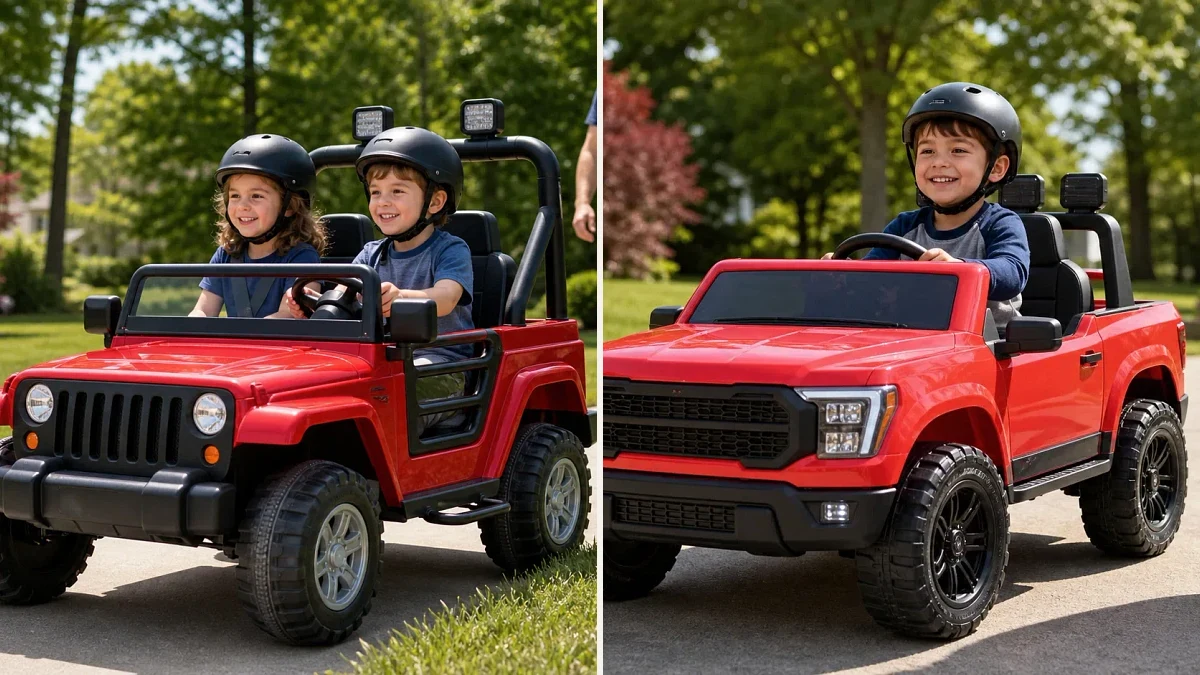
Buy the Jeep Wrangler if two kids will ride it or your yard is mostly grass. Buy the F-150 Raptor for one truck-obsessed kid who will spend as much time opening the hood as driving — the styling details and under-hood storage are what he's actually asking for.
These are the two flagship licensed vehicles in the Power Wheels lineup, and choosing between them stumps parents precisely because the spec sheets look identical. They mostly are. The real differences live in three places: seating, terrain, and theater.
What's the Same (Most of It)
Both are 12V. Both run 5 mph on high, 2.5 mph on low, with a parent-lockable high-speed screw. Both reverse. Both carry around 130 lbs across a two-kid bench. Both are built on the Power Wheels platform that's survived four decades of driveway abuse, with the same battery, the same charger, and the same deep parts ecosystem when something eventually wears out. Neither includes a parental remote — Power Wheels still doesn't do remotes, and if that's a dealbreaker, you're shopping a different brand entirely.
So no, you're not choosing between a fast one and a slow one, or a strong one and a weak one. You're choosing between two personalities on the same skeleton.
Seating: The Wrangler's Quiet Advantage
Both technically seat two, but they don't seat two equally. The Wrangler's open, doorless cab gives the second rider real space and easy entry — two four-year-olds climb in from either side and coexist without elbow warfare. The Raptor's enclosed truck cab is the snugger space; two smaller kids fit, but it rides best as a one-kid truck, and by the time your rider is 5-6, the passenger seat is more theoretical than useful.
If siblings, cousins, or the neighbor kid are in the picture regularly, this single difference should decide it. A two-seater that comfortably seats two prevents more driveway disputes than any other feature you can buy.
Terrain: Advantage Wrangler, By a Nose
Neither vehicle is an off-roader, but the Wrangler is the better grass machine. Its dual-motor setup and gearing handle lawns and modest slopes with less bogging, which matches how Jeep families tend to use it — driving on the yard, not just the driveway. The Raptor sits respectably here too, with good ground clearance for a 12V truck, but on thicker grass it works harder. Pavement-and-driveway households will notice no difference at all.
Theater: Advantage Raptor, Clearly
This is where the Raptor earns its buyers. The licensed detailing is the best in the Power Wheels stable — the proportions, the grille, the bedside graphics all read as a real Raptor shrunk to kid scale. And then there's the under-hood storage compartment, which sounds trivial until you watch a 4-year-old ceremonially stow a juice box, two rocks, and a toy wrench before every single drive. For a truck kid, the Raptor isn't transportation. It's a full identity, with cargo rituals.
The Wrangler's styling is good — the shape is unmistakable and the badge lands — but it hasn't changed much in years, and next to the Raptor's detail work it reads simpler.
Price and the Actual Decision
Both float in the $300-400 range depending on the retail weather, usually within $50 of each other — close enough that price shouldn't drive this. So let the use case do it. Two riders or real grass: Wrangler, and it's not close. One kid who points at every truck on the highway: Raptor, and he will never know the Wrangler existed. A kid who'd love either: buy whichever is discounted the week you're shopping, because underneath the theater it's the same excellent machine.
Quick Comparison
Power Wheels Jeep Wrangler
Power Wheels (Fisher-Price)
Best for two kids and grassy yards — the roomier, more capable flagship
- Voltage
- 12V
- Seats
- 2
- Ages
- 3-7 years
- Price
- $300-$400
Power Wheels Ford F-150 Raptor
Power Wheels (Fisher-Price)
Best for the truck-obsessed kid — the finest styling in the lineup
- Voltage
- 12V
- Seats
- 2
- Ages
- 3-7 years
- Price
- $300-$400
Power Wheels Dune Racer Extreme
Power Wheels (Fisher-Price)
Best alternative if terrain matters more than the badge
- Voltage
- 12V
- Seats
- 2
- Ages
- 3-7 years
- Price
- $290-$380
Kid Trax Ram 3500 Dually
Kid Trax
Best truck alternative for Ram families
- Voltage
- 12V
- Seats
- 2
- Ages
- 3-7 years
- Price
- $300-$400
Best Choice Products 12V Ride-On Truck
Best Choice Products
Best budget truck — features over longevity
- Voltage
- 12V
- Seats
- 1-2
- Ages
- 3-6 years
- Price
- $200-$300
| Product | Best For | Specs | Price | Rating |
|---|---|---|---|---|
Power Wheels Jeep Wrangler Power Wheels (Fisher-Price) | Best for two kids and grassy yards — the roomier, more capable flagship | 12V · 2 seats Ages 3-7 years | $300-$400 | 4.5 |
Power Wheels Ford F-150 Raptor Power Wheels (Fisher-Price) | Best for the truck-obsessed kid — the finest styling in the lineup | 12V · 2 seats Ages 3-7 years | $300-$400 | 4.6 |
Power Wheels Dune Racer Extreme Power Wheels (Fisher-Price) | Best alternative if terrain matters more than the badge | 12V · 2 seats Ages 3-7 years | $290-$380 | 4.6 |
Kid Trax Ram 3500 Dually Kid Trax | Best truck alternative for Ram families | 12V · 2 seats Ages 3-7 years | $300-$400 | 4.3 |
Best Choice Products 12V Ride-On Truck Best Choice Products | Best budget truck — features over longevity | 12V · 1-2 seats Ages 3-6 years | $200-$300 | 4.2 |
Prices are approximate and subject to change. Always verify current pricing before purchasing.
Our Picks — In Detail
Power Wheels Jeep Wrangler
Power Wheels (Fisher-Price)
12VSeats
2Ages
3-7 yearsPrice
$300-$400
The open, doorless cab is the feature: two kids climb in from either side and both get real space. Dual motors handle grass better than most 12V vehicles, and the platform's parts ecosystem is the deepest in the category. The default choice for siblings.
Pros
- Genuinely usable two-kid seating with easy entry
- Best grass performance of the two flagships
- Iconic Jeep styling with broad appeal
Cons
- No parental remote at this price
- Styling is simpler and older than the Raptor's detail work
Power Wheels Ford F-150 Raptor
Power Wheels (Fisher-Price)
12VSeats
2Ages
3-7 yearsPrice
$300-$400
The best licensed detailing Power Wheels makes, plus the under-hood storage compartment that turns every drive into a cargo ritual. Good ground clearance for a 12V truck and the same reliable platform underneath. Rides best as a one-kid vehicle — the cab is snug for two.
Pros
- Authentic Raptor styling and detail work
- Under-hood storage kids obsess over
- High/low settings for progressive learning
Cons
- Cab is snug — the second seat is mostly theoretical past age 5
- Works harder than the Wrangler on thick grass
Power Wheels Dune Racer Extreme
Power Wheels (Fisher-Price)
12VSeats
2Ages
3-7 yearsPrice
$290-$380
If you're choosing the Wrangler mainly for grass capability, look here first: welded steel frame, Monster Traction dual motors, a lower center of gravity than either flagship, and usually a lower price. What it lacks is exactly what the flagships sell — a licensed fantasy.
Pros
- Steel frame and the best stability of the three
- Strongest grass and light-dirt performance
- Often cheaper than either licensed flagship
Cons
- Open buggy styling — no Jeep or truck fantasy
- No storage or body theater to play with
Kid Trax Ram 3500 Dually
Kid Trax
12VSeats
2Ages
3-7 yearsPrice
$300-$400
If the driveway truck is a Ram, the Raptor badge solves nothing. Kid Trax's six-wheeled dually delivers the matching-truck fantasy with a roomier cab than the Raptor, at a similar price. The tradeoff is Kid Trax's lighter build and thinner parts support.
Pros
- Dually styling commitment — six actual wheels
- Roomier two-kid cab than the Raptor
- Licensed Ram look Power Wheels doesn't offer
Cons
- Lighter build quality than Power Wheels
- Weaker battery ecosystem and resale value
Best Choice Products 12V Ride-On Truck
Best Choice Products
12VSeats
1-2Ages
3-6 yearsPrice
$200-$300
The value counterpoint: a 12V truck with a parental remote, lights, and sounds for less than either flagship. It won't survive a second child the way a Power Wheels will, but for one kid's window with remote control included, the math is genuinely competitive.
Pros
- Parental remote included — neither flagship has one
- Lights, sounds, and features at a lower price
- Lighter and easier to store
Cons
- Thinner plastics won't survive multi-kid careers
- Generic truck styling without a real license
What to Look For
Voltage (6V / 12V / 24V)
Higher voltage means more power, higher top speed, and better terrain handling. Choose based on your child's age, size, and where they'll ride. 12V is the most popular choice for ages 3–7.
Number of Seats
Single-seat models work for one child; two-seat designs are great for siblings or friends. Two-seaters often put more strain on the motor, so look for adequate power.
Terrain
Most 12V ride-ons handle flat grass and hard surfaces. If you have hills, rough grass, or gravel, look for 24V models with high-traction tires.
Safety Features
Look for seat belts, parental lockout switches, low/high speed settings, and parental remote controls — especially for younger or first-time riders.
Battery & Charging
Check battery life (usually 1–2 hours for 12V) and charge time (8–18 hours). Some premium models offer faster charging or higher-capacity batteries.