Peg Perego John Deere Gator vs. Polaris RZR 900: Utility or Speed?
Peg Perego's two flagship two-seaters compared: the John Deere Gator XUV for utility play and hauling, the Polaris RZR 900 for speed and sport. Which fits your kid.
Affiliate Disclosure
This page contains affiliate links. As an Amazon Associate, PowerWheels HQ may earn a commission on qualifying purchases at no extra cost to you. Our reviews and recommendations are editorially independent.
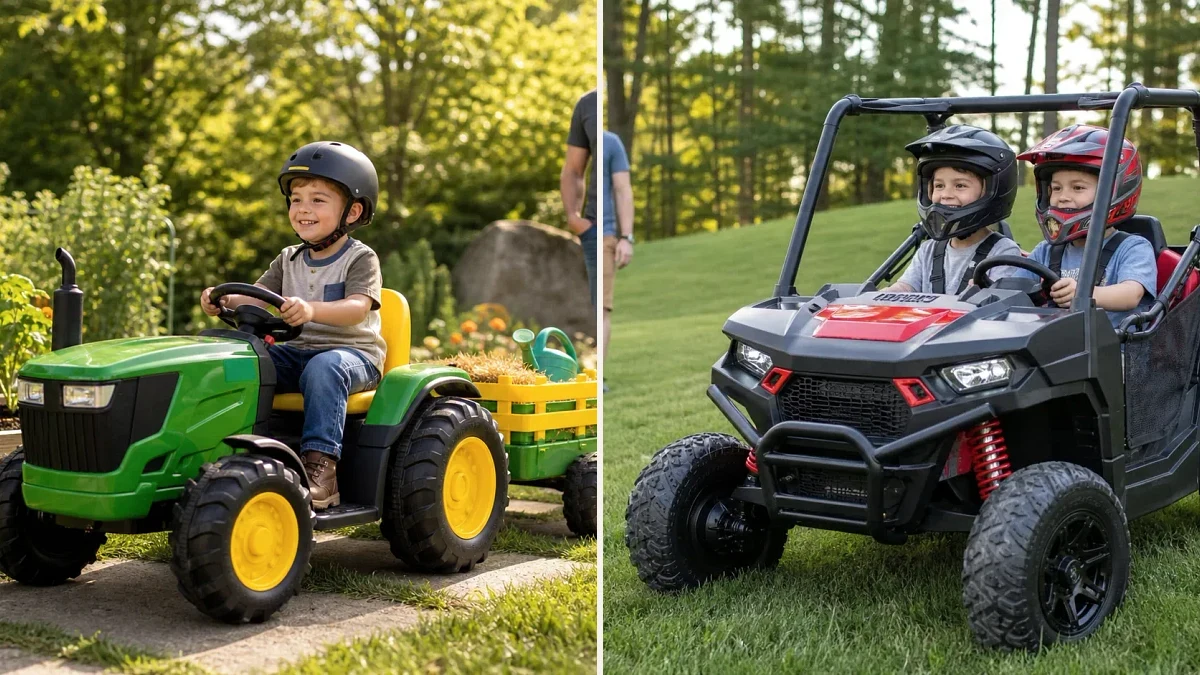
Buy the John Deere Gator XUV for the kid who wants to work: haul mulch, dump gravel, patrol the yard like a groundskeeper. Buy the Polaris RZR 900 for the kid who wants to go fast — 7 mph on the top setting, which is the fastest a two-seater in this age range legitimately gets. The Gator skews slightly younger; the RZR rewards a kid who's ready for real speed.
This is not a quality decision. Both are Peg Perego, and Peg Perego does not build a cheap version of anything. It's a personality decision, and most parents know within ten seconds of reading this which kid they have.
What They Share
Both are two-seaters rated for ages 3-8. Both come from the same Italian company with the same engineering DNA: motors and gearboxes that outlast the plastic-wheeled competition by years, adjustable seats that extend the usable window as kids grow, traction wheels that actually grip grass, and parent-selectable speed settings so you can start slow and unlock speed as skills develop. Both carry the same quirk, too — a marathon first charge (up to 18 hours), which is the most Italian thing about them. Plan for that before the birthday morning, not during it.
If your criterion is "which one is built better," stop comparing. They're the same build. Everything below is about what the vehicle does, not how well it's made.
The Gator: Utility Play at a Working Pace
The Gator XUV is a 12V vehicle with a working dump bed, and the dump bed is the entire point. Kids load it with mulch, rocks, stuffed animals, a sibling's shoes — then drive across the yard and dump it. Then do it again. For hours. There's a category of kid, usually the tractor-and-construction-equipment kid, for whom this loop is the greatest game ever invented.
Top speed is a deliberate 4.5 mph. That's not a weakness; it's a design choice. A utility vehicle that hauls cargo wants a measured pace, and it makes the Gator comfortable for kids on the younger end of the range — a cautious 3-year-old is at home here in a way they aren't in the RZR. The licensed John Deere green-and-yellow is accurate enough that farm-adjacent adults do a double-take.
The RZR 900: Speed and Stance
The Polaris RZR 900 is the 24V sports option. Three speed settings run from 2.5 to 7 mph, and 7 mph with two kids aboard on grass is something 12V two-seaters simply don't do. The 24V system also means it holds speed on inclines and thick lawn where lower-voltage vehicles bog down.
The stance matches: low, wide, aggressive, with licensed RZR bodywork that reads as a real side-by-side shrunk down. There's no dump bed and no pretense of work. It's a sport machine, and the kid who wants it knows they want it.
The Honest Limitations
The Gator's: speed-hungry kids get bored with 4.5 mph by age 6, and there's no upgrade setting waiting for them. If your kid already complains that their 12V car is slow, the Gator will not fix that.
The RZR's: 7 mph requires a kid who's ready for it and a yard that can absorb it. It also usually costs more than the Gator, and if the top speed stays locked out because your kid isn't ready, you've paid for capability you're not using. A cautious kid doesn't grow braver because the vehicle is faster.
The Pick, Restated
Ages 3-5, loves tractors, plays in loops: Gator, easily. Ages 5-8, wants speed, has the yard for it: RZR 900, easily. Kid who wants both? The dump bed loses to the speedometer around age six. Buy accordingly.
Quick Comparison
Peg Perego John Deere Gator XUV
Peg Perego
Best for utility play — the working dump bed is the whole game
- Voltage
- 12V
- Seats
- 2
- Ages
- 3-8 years
- Price
- $400-$550
Peg Perego Polaris RZR 900
Peg Perego
Best for speed — 7 mph is the ceiling for this age group
- Voltage
- 24V
- Seats
- 2
- Ages
- 3-8 years
- Price
- $550-$700
Peg Perego John Deere Ground Force
Peg Perego
Best tractor alternative — driver's seat plus a tow-behind trailer
- Voltage
- 12V
- Seats
- 2
- Ages
- 3-7 years
- Price
- $300-$400
Power Wheels Jeep Wrangler
Power Wheels (Fisher-Price)
Best budget alternative if neither Peg Perego fits the budget
- Voltage
- 12V
- Seats
- 2
- Ages
- 3-7 years
- Price
- $300-$400
| Product | Best For | Specs | Price | Rating |
|---|---|---|---|---|
Peg Perego John Deere Gator XUV Peg Perego | Best for utility play — the working dump bed is the whole game | 12V · 2 seats Ages 3-8 years | $400-$550 | 4.6 |
Peg Perego Polaris RZR 900 Peg Perego | Best for speed — 7 mph is the ceiling for this age group | 24V · 2 seats Ages 3-8 years | $550-$700 | 4.7 |
Peg Perego John Deere Ground Force Peg Perego | Best tractor alternative — driver's seat plus a tow-behind trailer | 12V · 2 seats Ages 3-7 years | $300-$400 | 4.5 |
Power Wheels Jeep Wrangler Power Wheels (Fisher-Price) | Best budget alternative if neither Peg Perego fits the budget | 12V · 2 seats Ages 3-7 years | $300-$400 | 4.5 |
Prices are approximate and subject to change. Always verify current pricing before purchasing.
Our Picks — In Detail
Peg Perego John Deere Gator XUV
Peg Perego
12VSeats
2Ages
3-8 yearsPrice
$400-$550
A licensed John Deere side-by-side with a working dump bed and a deliberate 4.5 mph pace. For the tractor kid, the load-haul-dump loop is endlessly replayable, and Peg Perego's build quality means the bed hinge and gearboxes survive years of it. Skews slightly younger than the RZR.
Pros
- Working dump bed drives hours of hauling play
- Measured 4.5 mph pace suits cautious and younger riders
- Accurate licensed John Deere styling
Cons
- Speed-focused kids get bored with it by age 6
- No high-speed setting to grow into
Peg Perego Polaris RZR 900
Peg Perego
24VSeats
2Ages
3-8 yearsPrice
$550-$700
The fastest legitimate two-seater for ages 3-8. Three speed settings from 2.5 to 7 mph, 24V power that holds pace uphill and through thick grass, and a low sport stance in licensed RZR bodywork. The speed settings let a parent stage the performance as skills develop.
Pros
- 7 mph top speed with two kids aboard, even on grass
- 24V power handles hills and terrain that stall 12V rivals
- Three parent-selectable speed settings stage the progression
Cons
- Costs meaningfully more than the Gator
- First charge takes up to 18 hours
Peg Perego John Deere Ground Force
Peg Perego
12VSeats
2Ages
3-7 yearsPrice
$300-$400
The classic tractor take on the Gator formula: one driver up front, a passenger or cargo in the towed trailer. Cheaper than the Gator, same Peg Perego 12V quality, and arguably more "tractor" for the kid who wants the genuine farm silhouette rather than a side-by-side.
Pros
- Trailer doubles as passenger seat or cargo hauler
- Classic tractor styling for the true John Deere kid
- Lower price than either flagship two-seater
Cons
- Trailer passenger gets a bumpier, less secure ride than a real second seat
- Slow, deliberate pace — this is not a speed machine
Power Wheels Jeep Wrangler
Power Wheels (Fisher-Price)
12VSeats
2Ages
3-7 yearsPrice
$300-$400
Not a Peg Perego, and it doesn't pretend to be — but it's a proven 12V two-seater at $150-300 less than the Gator or RZR. No dump bed, no 7 mph, just the most established two-seat platform in the category. The sensible pick when the Peg Perego premium doesn't fit.
Pros
- Significantly cheaper than either Peg Perego flagship
- Proven durability and deep parts availability
- Licensed Jeep styling with broad kid appeal
Cons
- 5 mph ceiling and no working accessories
- Build quality is a clear step below Peg Perego
What to Look For
Voltage (6V / 12V / 24V)
Higher voltage means more power, higher top speed, and better terrain handling. Choose based on your child's age, size, and where they'll ride. 12V is the most popular choice for ages 3–7.
Number of Seats
Single-seat models work for one child; two-seat designs are great for siblings or friends. Two-seaters often put more strain on the motor, so look for adequate power.
Terrain
Most 12V ride-ons handle flat grass and hard surfaces. If you have hills, rough grass, or gravel, look for 24V models with high-traction tires.
Safety Features
Look for seat belts, parental lockout switches, low/high speed settings, and parental remote controls — especially for younger or first-time riders.
Battery & Charging
Check battery life (usually 1–2 hours for 12V) and charge time (8–18 hours). Some premium models offer faster charging or higher-capacity batteries.