Power Wheels vs. Best Choice Products: Legacy Durability or Maximum Features?
Power Wheels vs. Best Choice Products compared: durability, features per dollar, parts, and resale. Which ride-on brand actually fits how long you'll own it.
Affiliate Disclosure
This page contains affiliate links. As an Amazon Associate, PowerWheels HQ may earn a commission on qualifying purchases at no extra cost to you. Our reviews and recommendations are editorially independent.
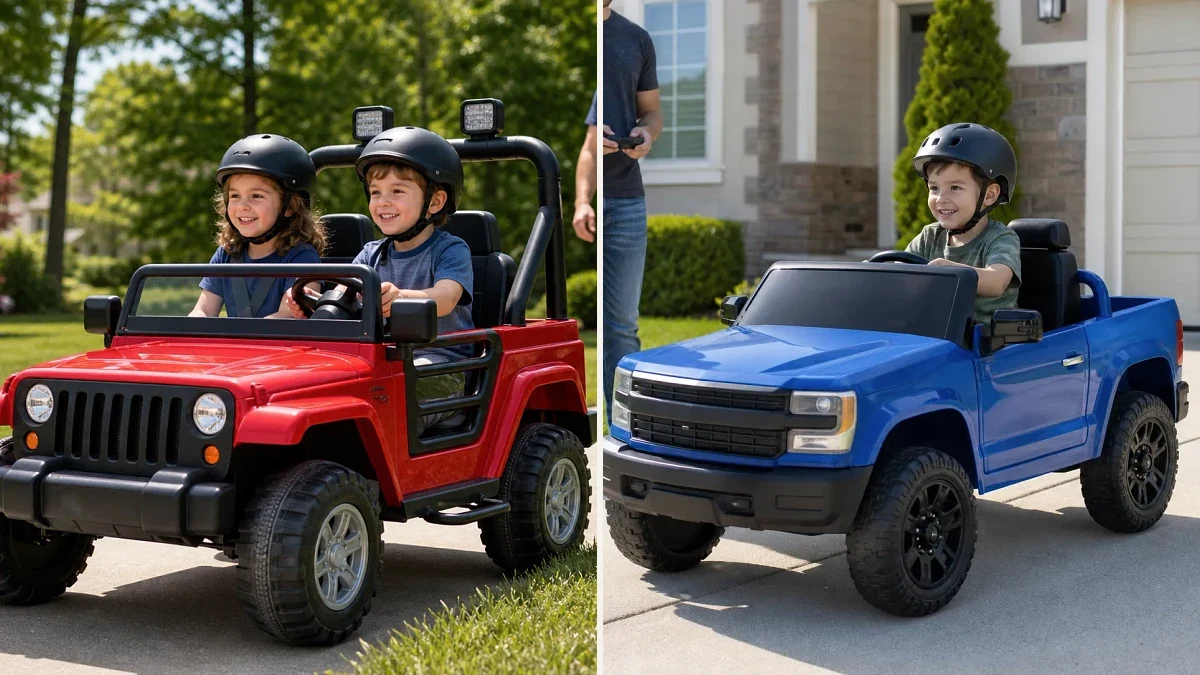
If you plan to hand this vehicle down to a second kid or sell it in three years, buy Power Wheels. If you want the maximum feature count for one kid's window of use — parental remote, Bluetooth speaker, LED lights, soft-start suspension — buy Best Choice Products and enjoy the savings. That's the entire decision, and both answers are correct for different houses.
What follows is why, because the two brands are playing completely different games.
Two Different Business Models, Two Different Vehicles
Power Wheels is a 1984-vintage legacy brand owned by Fisher-Price, built around a dealer-and-retail model: standardized batteries, an authorized service network, and designs that iterate slowly because they're expected to last. Best Choice Products is an Amazon-native brand built around the product listing: ship features that demo well, price aggressively, update the model yearly. Neither approach is wrong. But they produce very different objects.
Pick up a Power Wheels body panel and a BCP body panel and you can feel the strategy difference in your hands — the Power Wheels plastic is thicker, the fasteners are beefier, and the gearboxes carry four decades of iteration. The BCP vehicle carries the electronics: a 2.4GHz parental remote, Bluetooth audio, working LED headlights, spring suspension, and often scissor doors, at a price $50-150 below the comparable Power Wheels.
The Feature Gap Is Real — and So Is the Durability Gap
Let's be fair to BCP: the features aren't gimmicks. A parental remote is legitimately the most useful safety feature in the category for 2-4 year olds, and Power Wheels simply does not offer one. Suspension makes driveway cracks less jarring. The Bluetooth speaker will play the Bluey theme for the 37th time, which is a con disguised as a pro, but your kid disagrees.
Now the other side of the ledger. In owner reviews and our own tracking, the BCP failure pattern is consistent: the extras go first. Remote pairing gets flaky, speakers crackle, LEDs die — usually in year two — and the thinner body plastics crack at the mounting points under rough use. The core drivetrain often keeps working after the toys around it fail, but the vehicle feels tired at exactly the age a Power Wheels feels broken in.
Power Wheels' failure pattern is different: fewer features means fewer failure points, and when something does break, there's a replacement part and a repair forum waiting. That's what the premium buys — not luxury, longevity.
Batteries and Parts: The Year-Three Question
Power Wheels batteries are standardized and everywhere — original, third-party, higher-capacity upgrades. Any Power Wheels bought today will have battery availability for the next decade. BCP batteries vary by model and model year; replacements are findable now, but the model churn that keeps BCP's features fresh also means your specific battery and parts may be an archaeology project in year four.
The same logic extends to resale. A used Power Wheels Jeep in decent shape sells fast at 40-60% of retail. Used BCP vehicles sell slowly and cheaply, because buyers can't verify which features still work.
So Who Should Actually Buy What?
BCP is the right call more often than brand snobs admit: one child, ages 2-5, mostly driveway and sidewalk use, and a parent who wants the remote — that describes an enormous number of buyers, and for them the Power Wheels premium buys durability they will never use. Take the savings and the features.
Power Wheels is the right call when the timeline stretches: multiple kids, rough or grassy terrain, a family culture of handing things down, or a parent who'd rather repair than replace. Amortized over two kids and a resale, it's the cheaper brand.
The mistake is buying BCP and expecting a six-year vehicle, or buying Power Wheels for one gentle kid and paying for a decade you won't use.
Quick Comparison
Power Wheels Jeep Wrangler
Power Wheels (Fisher-Price)
The durability benchmark — what BCP is measured against
- Voltage
- 12V
- Seats
- 2
- Ages
- 3-7 years
- Price
- $300-$400
Power Wheels Ford F-150 Raptor
Power Wheels (Fisher-Price)
Best Power Wheels styling — the legacy brand's flashiest effort
- Voltage
- 12V
- Seats
- 2
- Ages
- 3-7 years
- Price
- $300-$400
Best Choice Products Lamborghini Urus
Best Choice Products
The BCP thesis in one vehicle — maximum theater per dollar
- Voltage
- 12V
- Seats
- 1
- Ages
- 2-6 years
- Price
- $220-$300
Best Choice Products 12V Ride-On Truck
Best Choice Products
Best BCP value — remote and suspension under $300
- Voltage
- 12V
- Seats
- 1-2
- Ages
- 3-6 years
- Price
- $200-$300
Best Choice Products Police Car
Best Choice Products
Best budget themed ride-on with a remote
- Voltage
- 12V
- Seats
- 1
- Ages
- 2-6 years
- Price
- $180-$260
| Product | Best For | Specs | Price | Rating |
|---|---|---|---|---|
Power Wheels Jeep Wrangler Power Wheels (Fisher-Price) | The durability benchmark — what BCP is measured against | 12V · 2 seats Ages 3-7 years | $300-$400 | 4.5 |
Power Wheels Ford F-150 Raptor Power Wheels (Fisher-Price) | Best Power Wheels styling — the legacy brand's flashiest effort | 12V · 2 seats Ages 3-7 years | $300-$400 | 4.6 |
Best Choice Products Lamborghini Urus Best Choice Products | The BCP thesis in one vehicle — maximum theater per dollar | 12V · 1 seat Ages 2-6 years | $220-$300 | 4.4 |
Best Choice Products 12V Ride-On Truck Best Choice Products | Best BCP value — remote and suspension under $300 | 12V · 1-2 seats Ages 3-6 years | $200-$300 | 4.2 |
Best Choice Products Police Car Best Choice Products | Best budget themed ride-on with a remote | 12V · 1 seat Ages 2-6 years | $180-$260 | 4.2 |
Prices are approximate and subject to change. Always verify current pricing before purchasing.
Our Picks — In Detail
Power Wheels Jeep Wrangler
Power Wheels (Fisher-Price)
12VSeats
2Ages
3-7 yearsPrice
$300-$400
No remote, no Bluetooth, no suspension — and it will still be running when the third kid inherits it. The Wrangler is the clearest expression of the Power Wheels trade: fewer features, more years. Standardized batteries and deep parts availability seal the argument.
Pros
- Survives multi-kid, multi-year careers routinely
- Standardized battery with replacements everywhere
- Strong resale value — 40-60% of retail used
Cons
- No parental remote at any price
- Feature-light next to BCP at the same money
Power Wheels Ford F-150 Raptor
Power Wheels (Fisher-Price)
12VSeats
2Ages
3-7 yearsPrice
$300-$400
The closest Power Wheels comes to feature theater: authentic Raptor detailing and under-hood storage on the same durable platform. Still no remote and no speaker — the brand's answer to BCP is styling and longevity, not electronics.
Pros
- Best licensed detail work in the legacy lineup
- Under-hood storage kids genuinely use
- Proven platform with high/low speed settings
Cons
- Costs more than feature-rich BCP equivalents
- No electronics — no remote, lights show, or audio
Best Choice Products Lamborghini Urus
Best Choice Products
12VSeats
1Ages
2-6 yearsPrice
$220-$300
Scissor doors that open vertically like the real Urus, a 2.4GHz parental remote, Bluetooth audio, LED lights, and spring suspension — for less than a featureless Power Wheels. This is why BCP wins the one-kid window: no legacy vehicle generates this reaction at the park.
Pros
- Scissor doors and licensed Lamborghini styling
- Parental remote included — the key toddler safety feature
- Bluetooth, LEDs, and suspension at a mid-range price
Cons
- Electronics are the first thing to fail, typically year two
- Single seat and lighter build limit the lifespan
Best Choice Products 12V Ride-On Truck
Best Choice Products
12VSeats
1-2Ages
3-6 yearsPrice
$200-$300
BCP's bread and butter: a truck-styled 12V with parental remote, lights, sounds, and spring suspension at a price the legacy brands don't match. For one kid on a driveway, it delivers 90% of the experience for 70% of the money — for about three years.
Pros
- Remote, suspension, and sound features standard
- Aggressive pricing well under the flagships
- Soft-start acceleration is gentler for beginners
Cons
- Thinner plastics crack at mounting points under rough use
- Generic styling without a real vehicle license
Best Choice Products Police Car
Best Choice Products
12VSeats
1Ages
2-6 yearsPrice
$180-$260
Lights, siren sounds, and a parental remote at a price where Power Wheels offers nothing at all. For the 2-4 year old cop-car phase — which lasts about as long as this vehicle will — the value math works perfectly. Just don't expect a hand-me-down.
Pros
- Working light and siren theater kids love
- Remote control for the youngest drivers
- Low price fits a short interest phase
Cons
- Not built for a second child's career
- Replacement parts support is minimal
What to Look For
Voltage (6V / 12V / 24V)
Higher voltage means more power, higher top speed, and better terrain handling. Choose based on your child's age, size, and where they'll ride. 12V is the most popular choice for ages 3–7.
Number of Seats
Single-seat models work for one child; two-seat designs are great for siblings or friends. Two-seaters often put more strain on the motor, so look for adequate power.
Terrain
Most 12V ride-ons handle flat grass and hard surfaces. If you have hills, rough grass, or gravel, look for 24V models with high-traction tires.
Safety Features
Look for seat belts, parental lockout switches, low/high speed settings, and parental remote controls — especially for younger or first-time riders.
Battery & Charging
Check battery life (usually 1–2 hours for 12V) and charge time (8–18 hours). Some premium models offer faster charging or higher-capacity batteries.