Ride-On Toy Storage Ideas for Small Garages
Practical storage ideas for ride-on cars — garage solutions, outdoor covers, what not to do, and the habits that protect your investment year-round.
Affiliate Disclosure
This page contains affiliate links. As an Amazon Associate, PowerWheels HQ may earn a commission on qualifying purchases at no extra cost to you. Our reviews and recommendations are editorially independent.
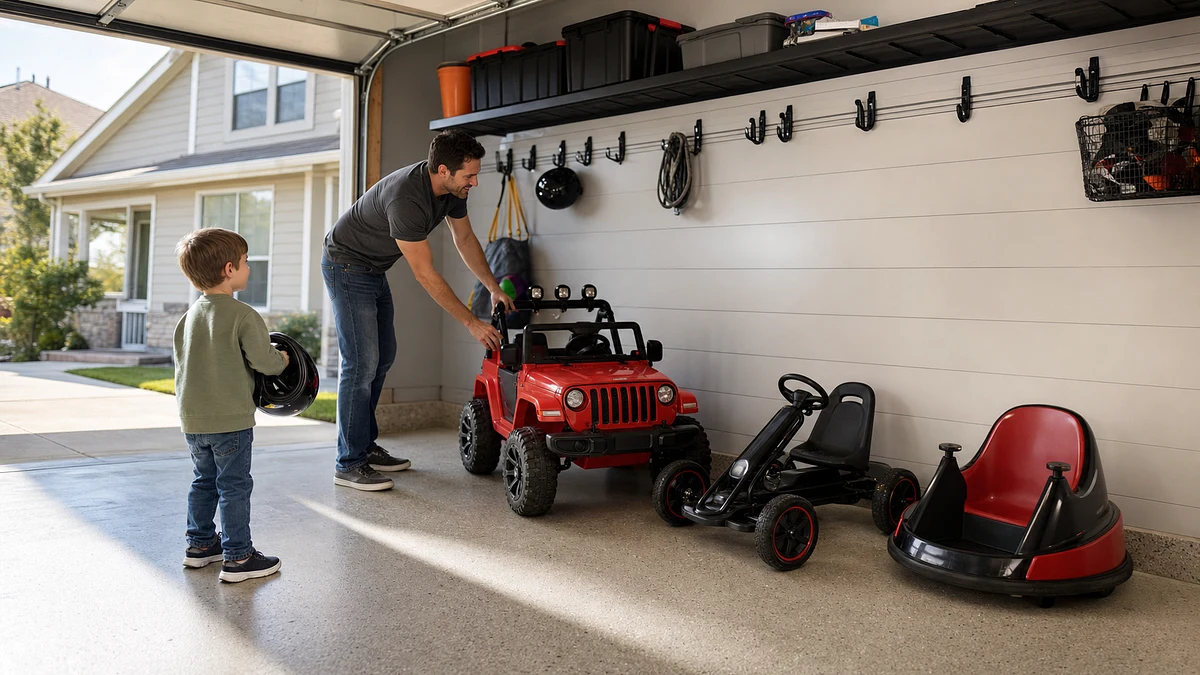
The ride-on car was exciting until you parked it in the garage and realized it takes up the same floor space as a large stroller — permanently. This is the problem nobody mentions when you're buying one: these things are physically large, they can't be folded, and they don't stack. You now own an object the size of a go-kart that needs to live somewhere.
Most parents default to leaving it on the garage floor, and that works until winter, until someone needs to park a second car, or until the battery dies from months of cold neglect. There are better options.
The Floor Space Problem
A standard Power Wheels is roughly 4 feet long and 2 feet wide. A Dune Racer two-seater is closer to 4.5 by 2.5. These vehicles sit about as far forward in the garage as a large tricycle, but wider. If your garage is a one-car garage already at capacity, adding a ride-on means something else has to move or you're doing creative floor Tetris every time you want to park.
The honest solution for most garages is vertical storage or off-season staging — moving the vehicle to a basement, a shed, or an outdoor storage area when it's not being used daily.
Outdoor Storage: The Right Way
Leaving a ride-on outside is fine with the right cover. The non-negotiables are UV protection and waterproofing. Prolonged sun exposure fades plastic bodywork and degrades it over time. Water intrusion into electrical connections causes corrosion. A good fitted cover solves both.
Generic tarp covers are inexpensive but often trap moisture underneath due to poor ventilation. A properly sized car or toy cover with fabric that breathes is better. The Classic Accessories Polypro III line fits most ride-on cars reasonably well. Look for covers with tie-down straps so they don't blow off in wind.
What outdoor storage does not solve: battery care in cold weather. Even with a cover, if the ambient temperature drops below freezing and the battery is sitting dead, you're shortening its life. Before winter outdoor storage, always charge the battery fully and disconnect it from the vehicle. Bring the battery inside if temperatures will drop below 20°F.
Garage Wall Storage
For garages with wall space, a wall-mounted hook or bracket system can get the ride-on off the floor entirely. This sounds more dramatic than it is — most 12V ride-on cars weigh 25-40 lbs, which is well within the range of standard wall-mounted bike hooks rated for heavier loads.
The practical approach: two heavy-duty bicycle hooks (the kind rated for 50+ lbs each) mounted at the right height, positioned at the front wheels and rear axle. Lift the vehicle and hang it. This is a two-person job and requires your wall to have studs in the right locations, but it clears the entire floor footprint. Several brands make adjustable vertical storage racks designed for exactly this use — the RAD Cycle Products garage rack handles most ride-on sizes.
What Not to Do
Don't leave the battery dead in outdoor storage over winter. This is the single habit that causes most premature battery deaths. Charge it fully before any storage period longer than two weeks.
Don't leave the vehicle in direct weather without a cover. Sustained rain and UV exposure damage the electronics and body in ways that accelerate over time.
Don't store in a space where temperatures swing dramatically without disconnecting the battery. Repeated freeze-thaw cycles on a connected battery are hard on the cells.
Don't park it blocking your main garage walkway and assume it'll be fine because "you'll move it." You won't. It'll be in the way for six months.
The Seasonal Approach
Active season (spring through fall): keep it accessible on the garage floor or outside with a cover. Charge after every few uses.
Off-season (winter): charge fully, disconnect the battery, store battery inside at room temperature, put a cover on the vehicle, and park it where it won't block anything. Reconnect and charge again in spring before first use.
This routine takes about 20 minutes at the start and end of winter and will meaningfully extend battery life over multiple years.
Quick Comparison
Classic Accessories Polypro III Power Sports Cover
Classic Accessories
Best outdoor cover for most ride-on sizes
- Voltage
- N/A
- Seats
- N/A
- Ages
- N/A
- Price
- $30-$60
RAD Cycle Products Heavy Duty Bike Rack
RAD Cycle Products
Best garage floor rack for clearing floor space
- Voltage
- N/A
- Seats
- N/A
- Ages
- N/A
- Price
- $45-$75
Heavy Duty Wall Mounted Bike Hook
Monkey Bars
Best for getting the vehicle completely off the floor
- Voltage
- N/A
- Seats
- N/A
- Ages
- N/A
- Price
- $20-$35
Battery Tender 12V Maintainer
Battery Tender
Best for battery maintenance during storage
- Voltage
- 12V
- Seats
- N/A
- Ages
- N/A
- Price
- $25-$45
| Product | Best For | Specs | Price | Rating |
|---|---|---|---|---|
Classic Accessories Polypro III Power Sports Cover Classic Accessories | Best outdoor cover for most ride-on sizes | N/A · N/A seats Ages N/A | $30-$60 | 4.4 |
RAD Cycle Products Heavy Duty Bike Rack RAD Cycle Products | Best garage floor rack for clearing floor space | N/A · N/A seats Ages N/A | $45-$75 | 4.3 |
Heavy Duty Wall Mounted Bike Hook Monkey Bars | Best for getting the vehicle completely off the floor | N/A · N/A seats Ages N/A | $20-$35 | 4.5 |
Battery Tender 12V Maintainer Battery Tender | Best for battery maintenance during storage | 12V · N/A seats Ages N/A | $25-$45 | 4.7 |
Prices are approximate and subject to change. Always verify current pricing before purchasing.
Our Picks — In Detail
Classic Accessories Polypro III Power Sports Cover
Classic Accessories
N/ASeats
N/AAges
N/APrice
$30-$60
Breathable polypropylene cover that resists water without trapping moisture underneath. Sized for ATVs and smaller power sports equipment — fits most ride-on cars well. Elastic hem and tie-down straps keep it in place in wind. UV-resistant fabric protects the bodywork through summer storage.
Pros
- Breathable material prevents moisture trap
- Tie-down straps prevent wind displacement
- UV protection preserves plastic bodywork
Cons
- Finding the exact right size requires measuring your vehicle
- More expensive than a generic tarp
RAD Cycle Products Heavy Duty Bike Rack
RAD Cycle Products
N/ASeats
N/AAges
N/APrice
$45-$75
A freestanding floor rack that holds multiple bikes and can be adapted to cradle a ride-on car in a vertical or tilted position. Doesn't require wall mounting — a significant advantage in garages where the stud layout doesn't cooperate. Holds up to 100 lbs.
Pros
- No wall mounting required
- Adjustable to fit different vehicle widths
- Holds up to 100 lbs
Cons
- Still takes some floor space (just vertical)
- Requires some assembly
Heavy Duty Wall Mounted Bike Hook
Monkey Bars
N/ASeats
N/AAges
N/APrice
$20-$35
Heavy-gauge steel hooks rated for 50+ lbs each. Mount to garage wall studs, hang the ride-on by its frame. Two hooks at the right spacing can cradle most ride-on cars off the floor entirely. Rubber coating prevents scratching the vehicle.
Pros
- Fully clears floor space
- Inexpensive per hook
- Rubber coating protects vehicle finish
Cons
- Requires stud location in the right place
- Two-person lift job for most vehicles
Battery Tender 12V Maintainer
Battery Tender
12VSeats
N/AAges
N/APrice
$25-$45
A trickle charger that keeps a 12V SLA battery at optimal charge without overcharging it during extended storage. Plug it in when you're putting the ride-on away for winter — the battery arrives at spring fully charged and in better condition than it would have been sitting disconnected. Pays for itself in battery longevity.
Pros
- Extends SLA battery life through proper maintenance
- Automatic — no overcharge risk
- Works on any standard 12V SLA battery
Cons
- Adds cost to the storage setup
- Requires an accessible power outlet
What to Look For
Voltage (6V / 12V / 24V)
Higher voltage means more power, higher top speed, and better terrain handling. Choose based on your child's age, size, and where they'll ride. 12V is the most popular choice for ages 3–7.
Number of Seats
Single-seat models work for one child; two-seat designs are great for siblings or friends. Two-seaters often put more strain on the motor, so look for adequate power.
Terrain
Most 12V ride-ons handle flat grass and hard surfaces. If you have hills, rough grass, or gravel, look for 24V models with high-traction tires.
Safety Features
Look for seat belts, parental lockout switches, low/high speed settings, and parental remote controls — especially for younger or first-time riders.
Battery & Charging
Check battery life (usually 1–2 hours for 12V) and charge time (8–18 hours). Some premium models offer faster charging or higher-capacity batteries.